
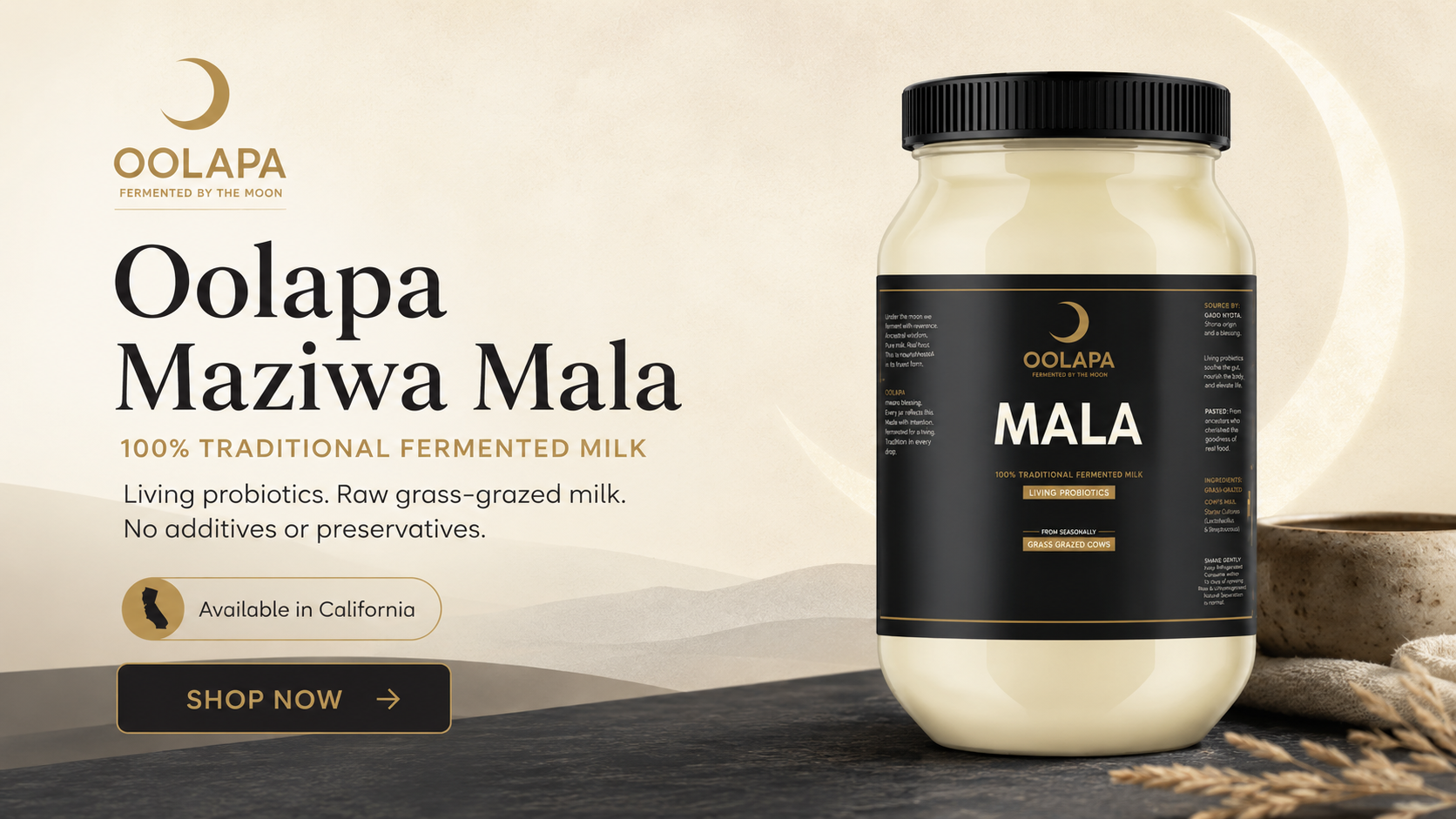
Oolapa is derived from Olapa, which means moon in Maa (the Maasai language). We chose this name because traditional fermentation wasn't measured in hours or days—it was measured in moon cycles.
This isn't poetic exaggeration. It's practical ancestral knowledge.
The Problem with Modern Fermentation
Walk into any food science lab, and they'll tell you fermentation is about control:
- Precise temperatures (98.6°F for yogurt, 68-78°F for kefir)
- Specific starter cultures (L. bulgaricus, S. thermophilus, etc.)
- Exact timing (8 hours for yogurt, 24 hours for kefir)
- Consistent results, batch after batch
This produces predictable products. But predictable isn't always better.
The Wisdom of Waiting
Traditional African fermentation operates on a completely different principle: trust time, not temperature.
No thermometers. Room temperature—wherever that happens to be—is fine. Warmer weather speeds fermentation slightly. Cooler weather slows it. The milk adapts.
No starter cultures. Raw milk already contains diverse beneficial bacteria. Charcoal fermentation creates the right environment for them to thrive.
No timers. You taste, you smell, you observe. When it's ready, it's ready. This might be one week. Or two. Or two months.
Moon cycles as a measurement. Before clocks and calendars dominated, people tracked time by the moon. A full moon cycle (28 days) became a natural unit of measurement. "This batch has been fermenting for one moon." "That one for two moons."
Moon cycles are visible, consistent, and can be observed without technology.
What Happens During Extended Fermentation
When you ferment for weeks instead of hours, remarkable things happen:
Week 1: Initial Transformation
The milk thickens. Lactic acid bacteria begin multiplying rapidly. pH drops. The tang develops. Most commercial fermentation stops here.
Week 2-3: Deepening Complexity
Bacterial diversity increases. Different strains emerge at different stages. Flavors become more complex, more developed. The product is fully alive now.
Week 4+: Maximum Development
Probiotic content reaches peak levels. The bacterial ecosystem is fully mature. Flavor is intense—bold, tangy, complex. This is what our ancestors knew: the longer the fermentation, the more beneficial the result.
Why Raw Milk Doesn't Rot
People often ask: "If you leave milk at room temperature for weeks, won't it spoil?"
Pasteurized milk? Yes. Heating milk kills both harmful and beneficial bacteria. When exposed to room temperature, any contaminating bacteria multiply freely. The result: spoilage.
Raw milk? No. Raw milk contains beneficial bacteria that create an acidic environment (low pH) hostile to pathogenic bacteria. This is protective fermentation—the same principle behind sauerkraut, kimchi, and sourdough.
Extended fermentation creates a pH below 4.6—the threshold at which pathogenic bacteria cannot survive. The milk doesn't rot; it transforms.
The Role of Charcoal
Activated charcoal from hardwood isn't just a filter—it's an active participant in fermentation.
It purifies by absorbing impurities and potential contaminants during fermentation.
It creates surface area for beneficial bacteria to colonize. The porous structure of charcoal provides millions of tiny spaces for bacterial cultures to develop.
It's traditional across many African fermentation practices—from milk to traditional brews.
Once fermentation reaches the desired stage, the charcoal is removed. What remains is pure fermented milk with no charcoal residue.
Living Products vs. Finished Products
Modern food culture treats fermentation as a process with an endpoint. You ferment yogurt, then you stop fermentation by refrigerating it. The product is "finished."
Traditional culture treats fermentation as ongoing. Maziwa mala continues developing even after it leaves our hands. Beneficial bacteria keep multiplying, keep transforming the milk.
Refrigerate it, and fermentation slows dramatically—the flavor mellows, stabilizes.
Keep it at room temperature, and fermentation continues—the flavor intensifies and evolves.
This makes every jar a living experience. The maziwa mala you drink today will taste slightly different from the same jar next week.
Why This Method Matters
Extended wild fermentation creates something commercial products can't replicate:
Bacterial diversity. Commercial yogurt has 2-10 strains. Kefir has 30-60. Traditional maziwa mala? Dozens to hundreds of strains, many of which haven't even been identified by science yet.
Probiotic density. More time = more beneficial bacteria. By the time fermentation reaches 4-8 weeks, you have maximum probiotic content.
Digestive adaptation. The complex bacterial ecosystem mirrors what human guts evolved with—diverse, wild, living.
Flavor depth. Quick fermentation creates a one-note tang. Extended fermentation creates layers of flavor—bright notes, deep notes, complex notes.
Reclaiming Time
In a culture obsessed with speed and efficiency, traditional fermentation is radical.
It says: some things can't be rushed. Some things get better with time. Some things require patience, not productivity.
Our ancestors knew this. They measured fermentation in moon cycles because they understood: transformation takes time.
At Oolapa, we're reclaiming that wisdom—one batch, one moon cycle, one jar at a time.
Next time: We'll dive into the health benefits of living probiotics and what modern science is discovering about ancestral fermentation.

0 comments