
Walk into any American grocery store, and you'll find shelves full of kefir, yogurt, and probiotic drinks. But ask for maziwa mala and you'll get blank stares.
That's because maziwa mala isn't a trendy new superfood—it's an ancient one. And until now, it's been hidden in plain sight, practiced in African communities for millennia but nearly invisible in Western food systems.
The Name
Maziwa mala comes from Swahili: maziwa means milk, mala means fermented or sour. Simple. Direct. Exactly what it is.
Across East Africa, fermented milk traditions span hundreds of ethnic communities, each with their own name and preparation methods. In Kenya alone: mursik among the Kalenjin, kule naoto among the Maasai, and iria rimati among the Meru. Throughout Tanzania, it's called mtindi by the Chagga and Hehe, while Uganda's Banyankole know it as omuramba. Rwanda and Burundi share ikivuguto, and Ethiopia's diverse communities prepare ergo. Though names, vessels, and techniques vary—from calabash to clay pot, cow to camel milk—the principle remains universal: raw milk, time, and natural transformation.
What Makes It Different
It's not yogurt.
Yogurt is made by adding commercial bacterial cultures (usually Lactobacillus bulgaricus and Streptococcus thermophilus) to heated milk, then incubating at precise temperatures for 4-12 hours.
It's not kefir.
Kefir uses kefir grains (a symbiotic culture of bacteria and yeast) added to milk, fermented for 12-48 hours at room temperature.
Maziwa mala is wild fermentation.
Raw milk. Charcoal fermentation. Room temperature. No commercial cultures. No temperature control. No modern shortcuts.
Just time—measured in weeks and months, not hours.
The Traditional Method
For thousands of years, African pastoral communities have made maziwa mala using gourds, calabashes, or clay pots. Fresh raw milk goes into the vessel. Activated charcoal from specific hardwoods is added during fermentation. The milk transforms over days, weeks, even months.
The charcoal isn't just filtration—it's part of the fermentation process itself. It acts as a natural purifier while beneficial bacteria colonize and transform the milk. Once fermentation reaches the desired stage, the charcoal is removed. What remains is pure, living fermented milk.
No one measures pH. No one checks temperature. The knowledge is passed down through generations: how it should smell, how it should taste, when it's ready.
Why You've Never Heard of It
It's not scalable. Modern food production demands consistency, speed, and shelf stability. Wild fermentation over weeks doesn't fit that model.
It's not pasteurized. US dairy regulations heavily favor (and in many cases require) pasteurization. Traditional fermented milk made from raw milk exists in a regulatory grey area.
It's cultural knowledge. The techniques were never written down in cookbooks or food science textbooks. They were taught mother to daughter, elder to young, through practice and observation.
It's been invisible. Until recently, African food traditions have been largely ignored or dismissed by mainstream food culture. Fermentation trends focused on kimchi, kombucha, and sourdough—rarely on African fermented foods.
But that's changing.
Why It Matters Now
The fermentation revival happening in Western food culture is finally making space for diverse traditions. People are seeking:
- Real probiotics - not lab-created cultures but wild, diverse bacterial ecosystems
- Ancestral foods - traditional preparations that supported human health for millennia
- Cultural authenticity - food with stories, not just ingredients lists
- Living products - foods that continue developing after you buy them
Maziwa mala offers all of this.
What It Tastes Like
Intensely tangy. Alive. Complex.
If you're used to commercial yogurt, maziwa mala will surprise you. The longer fermentation creates deeper, more developed flavors. The wild cultures create complexity that single-strain commercial products can't match.
It's sour, yes—but not unpleasantly so. It's the kind of sour that makes your mouth water, that signals: this is alive, this is good for you.
Traditionally, it's enjoyed in several ways. Many drink it plain, as our ancestors did—the pure, unadulterated tang that pastoral communities have savored for millennia. Others drizzle it with raw honey, creating a perfect balance between sour and sweet. It's also served alongside fermented breads like injera, where the double fermentation creates deep flavor harmony. And in traditional pastoral communities, it's often consumed with meat—the probiotics aiding digestion of protein and fat, simple and nutritionally complete.
This Is Just the Beginning
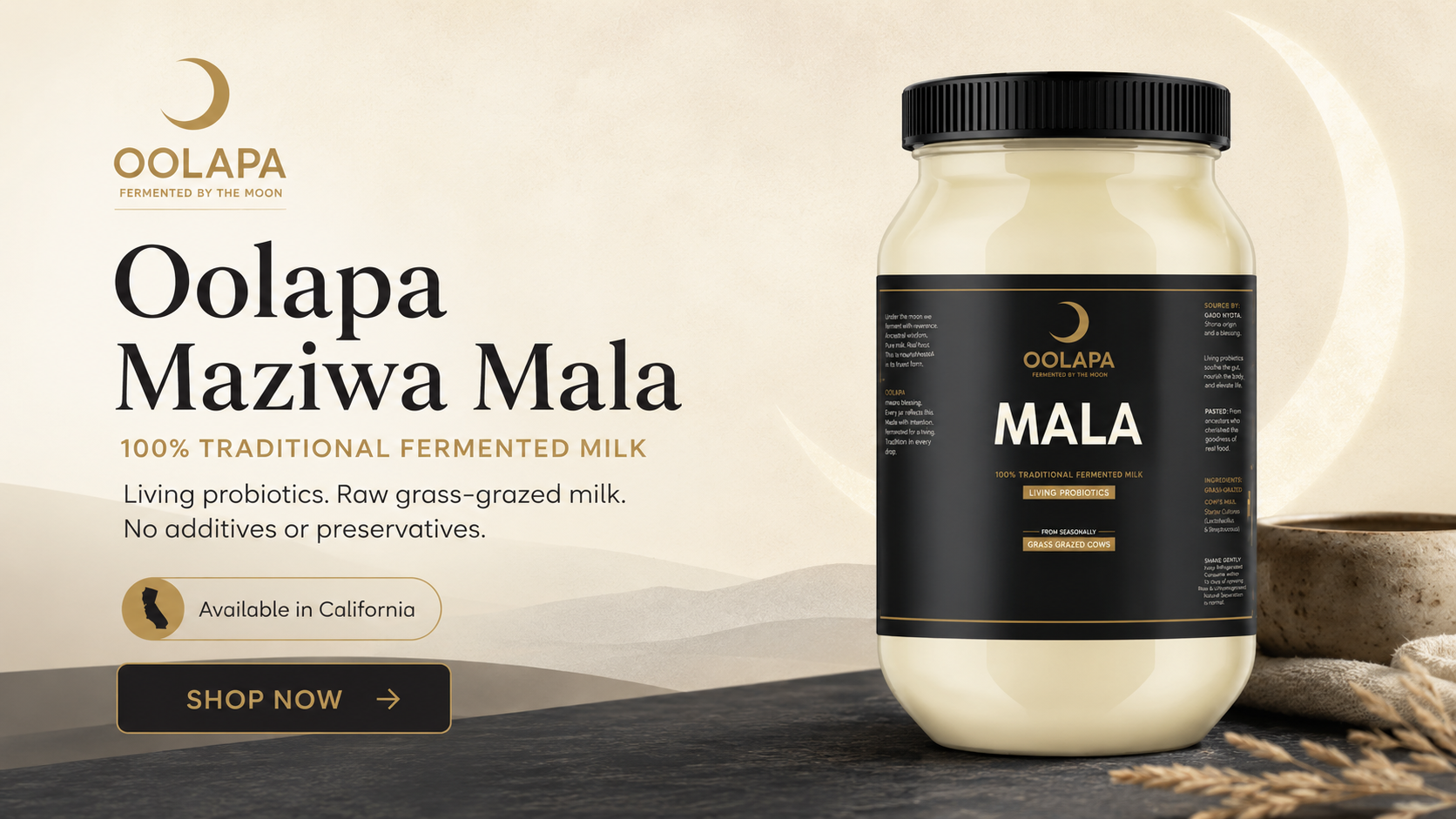
At Oolapa, we're bringing maziwa mala to a wider audience—not by modernizing it, but by preserving the traditional method. Raw grass-grazed milk. Charcoal fermentation. Time measured in moon cycles.
This isn't a new superfood. It's an old one, finally getting the recognition it deserves.
Next time, we'll explore why this traditional method produces superior probiotics.


2 comments
A noble begaining reintroducing the original milk nutrition to people-keeping it natural.
A noble begaining reintroducing the original milk nutrition to people-keeping it natural.